Classic Science Fiction · Crypsis Archive · Reading Lists
Forgotten Classics of Early Science Fiction: The Blue Germ and Tumithak of the Corridors
By Evan Couchot · · 4 min read
Ask most readers where science fiction began and you'll hear the same few names: Mary Shelley, Jules Verne, H. G. Wells, and then a jump to the Golden Age giants of the 1940s and 50s. But the decades in between were full of strange, ambitious stories that asked the questions the genre still asks today. Many of them simply fell out of print.
Two of those stories are now back on the shelf through The Crypsis Archive, our series of restored classic and pulp speculative fiction. One is a British scientific romance from 1918 about a cure that works far too well. The other is an American pulp adventure from 1932 about the last free humans living in tunnels beneath an Earth they no longer rule. Here's why both deserve a new generation of readers.
The Blue Germ (1918): The Cost of Immortality
The Blue Germ was published in London in 1918 under the pen name Martin Swayne. Behind the name was Maurice Nicoll (1884–1953), a Scottish physician and psychiatrist who served in the Royal Army Medical Corps during the First World War and worked alongside Carl Jung before turning to philosophy and psychology.
That background shows on every page. The novel follows Richard Harding, a London doctor obsessed with his patients' health, who creates a microscopic organism capable of destroying every known disease. Convinced he is saving humanity, he releases it into England's water supply. The infection spreads quickly, and its only visible sign is unsettling: the eyes and fingernails of the infected turn blue.
Then the true cost appears. Free from illness and decay, people lose the urgency that drives them. Love, ambition and desire fade into a nationwide apathy, and Harding has to face the possibility that he has given humanity eternal life at the price of everything that made living worthwhile.
Published in the year the great influenza pandemic swept the world, The Blue Germ reads today like a story about pandemics, medical overreach and what a cure is really for. It belongs on the same shelf as the "be careful what you invent" tradition that runs from Frankenstein to modern biotech thrillers.
Tumithak of the Corridors (1932): Humanity Underground
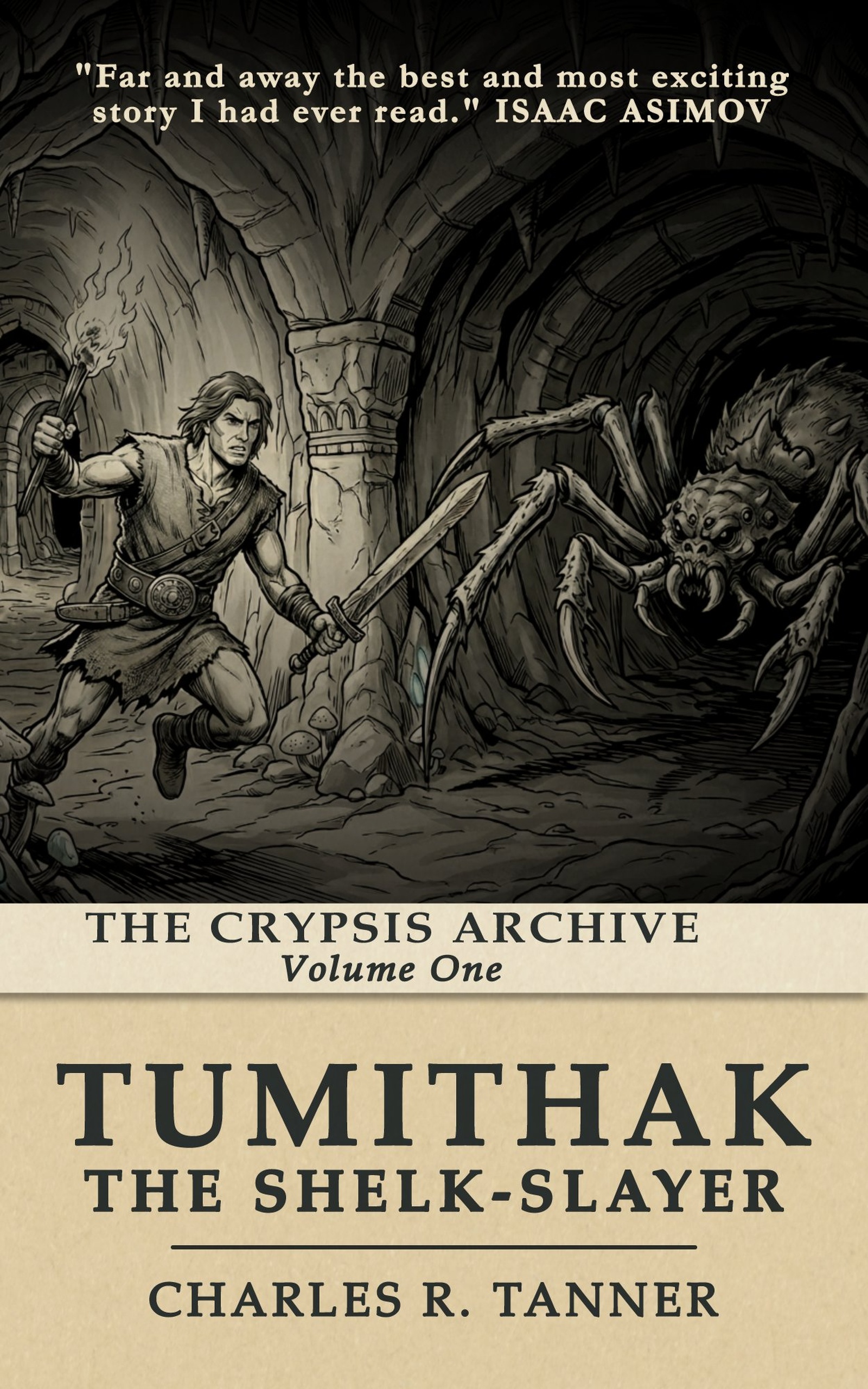
Fourteen years later and an ocean away, a Cincinnati writer named Charles R. Tanner (1896–1974) published "Tumithak of the Corridors" in the January 1932 issue of Amazing Stories, the magazine Hugo Gernsback had founded in 1926 as the first devoted entirely to science fiction.
The premise is still striking. Centuries after an invasion by the alien Shelk, humanity survives only as scattered, frightened communities in a maze of underground corridors. The surface is a myth; the sun is a legend. In the city of Loor, a young man named Tumithak refuses to accept that the Shelk can't be beaten, and he begins the long, dangerous climb toward a world no human has seen in a thousand years.
Tanner continued the story in "Tumithak in Shawm" (Amazing Stories, June 1933). Decades later, Isaac Asimov chose both stories for Before the Golden Age (1974), his anthology of the 1930s science fiction that shaped him as a young reader, which says a lot about how much they meant to the generation that built the genre.
Our edition, Tumithak The Shelk-Slayer, collects both novellas with a scientific foreword and a timeline of speculative fiction, so you can see exactly where Tanner's story sits in the history of the genre.
Read more about Tumithak The Shelk-Slayer
What These Two Stories Share
On the surface they couldn't be more different: one is a quiet, philosophical British novel, the other a fast-moving American pulp adventure. But both start with a single big "what if" and follow it all the way to its uncomfortable conclusion.
- Both question progress. Harding's cure and humanity's retreat underground are both stories about the cost of choosing safety over life.
- Both take science seriously for their time. Nicoll drew on his medical training; Tanner built a believable underground society with its own customs and fears.
- Both ask what makes us human once our ordinary struggles are taken away, by a germ or by an invader.
Reading Early Science Fiction Today
Stories from this era can feel unfamiliar at first. The prose is more formal, the pacing is different, and some attitudes belong firmly to their time. The reward is seeing ideas we now take for granted, from engineered pandemics to post-apocalyptic societies, when they were brand new and genuinely shocking.
That's the goal of The Crypsis Archive: restored texts with context, so these stories can be read as the bold experiments they were.
If You Enjoy These, Try...
- H. G. Wells, The Time Machine (1895): a far-future humanity split between the surface and the underground.
- E. M. Forster, "The Machine Stops" (1909): people living underground, wholly dependent on a global machine.
- Jack London, The Scarlet Plague (1912): a pandemic that unravels civilization.
- Mary Shelley, Frankenstein (1818): the original story of a scientist undone by his own creation.
Want to hear when the next Crypsis Archive title is restored? Join our newsletter and get a free short story or novella from Crypsis Press.